
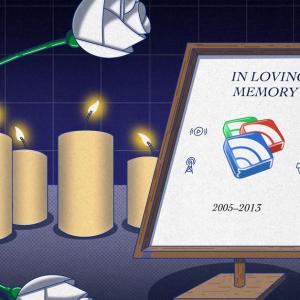
 Marien
But for users, [Google Reader] was a way of organizing the internet, for making sense of the web, for collecting all the things you care about no matter its location or type, and helping you make the most of it.
Wetherell and Shellen started imagining all the different kinds of feeds this tool could store. He thought it might bring in photo streams from Flickr, videos from YouTube and Google Videos, even podcasts from around the web. Shellen, who had come to Google as part of its Blogger acquisition, saw the possibility for a social network, a single place to follow all your friends’ blogs.
In other words, Fusion was meant to be a social network. One based on content, on curation, on discussion. In retrospect, what Shellen and Wetherell proposed sounds more like Twitter or Instagram than an RSS reader. “We were trying to avoid saying ‘feed reader,’” Shellen says, “or reading at all. Because I think we built a social product.”
So Fusion launched, as Google Reader, and immediately crashed spectacularly. The site simply couldn’t keep up with the traffic on the first day. Most of those early visitors to reader.google.com never came back, either. Even once the Reader team stabilized the infrastructure, lots of users hated the product; it had a lot of clever UI tricks but just didn’t work for too many users.
Google’s executives always seemed to think Reader was a feature, not a product. In meeting after meeting, they’d ask why Reader wasn’t just a tab in the Gmail app. When a team decided to build a new email client called Inbox, with promises of collecting all your important communication and information in one place, executives thought maybe Reader should be part of that.
The team was plotting new ways for users to discover content, new tools for sharing, and more. Bilotta urged executives to see the potential: “They could have taken the resources that were allocated for Google Plus, invested them in Reader, and turned Reader into the amazing social network that it was starting to be.”
It’s been a decade since Reader went offline, and a number of the folks who helped build it still ask themselves questions about it. What if they’d focused on growth or revenue and really tried to get to Google scale? What if they’d pushed harder to support more media types, so it had more quickly become the reader / photo viewer / YouTube portal / podcast app they’d imagined? What if they’d convinced Mayer and the other executives that Reader wasn’t a threat to Google’s social plans, but actually could be Google’s social plans? What if it hadn’t been called Reader and hadn’t been pitched as a power-user RSS feed aggregator?
Traduction à ma sauce :
Cela fait une décennie que Reader a été mis hors-ligne, et nombre de celles et ceux qui ont contribué à sa création se questionnent encore. Que ce serait-il passé s’ils s’étaient concentrés sur la croissance ou les revenues et avaient vraiment tenté de le faire passer à l’échelle de Google ? Que ce serait-il passé s’ils avaient redoublé d’efforts pour prendre en charge davantage de types de médias, devenant plus rapidement le lecteur / la visionneuse de photos / le portail YouTube / l’application de podcasts qu’ils avaient imaginé ? Que ce serait-il passé s’ils avaient convaincu Mayer et les autres dirigeants que Reader n’était pas une menace pour les projets de réseaux sociaux de Google, mais qu’il pouvait au contraire être ce projet ? Que ce serait-il passé s’il ne s’était pas appelé Reader et n’avait pas été présenté comme un agrégateur de flux RSS destiné aux utilisateurs expérimentés ?
For a while, the internet got away from what Google Reader was trying to build: everything moved into walled gardens and algorithmic feeds, governed by Facebook and Twitter and TikTok and others. But now, as that era ends and a new moment on the web is starting to take hold through Mastodon, Bluesky, and others, the things Reader wanted to be are beginning to come back.
Intéressant de découvrir comment Google Reader n’a jamais véritablement été apprécié en interne. Le produit a été très rapidement limité à un "agrégateur de flux RSS", alors que l’équipe qui bossait dessus rêvait de quelque chose de bien plus générique. Même le nom "Reader" était le moins aimé de la liste d’idées qu’ils avaient.